 fitri-handayani
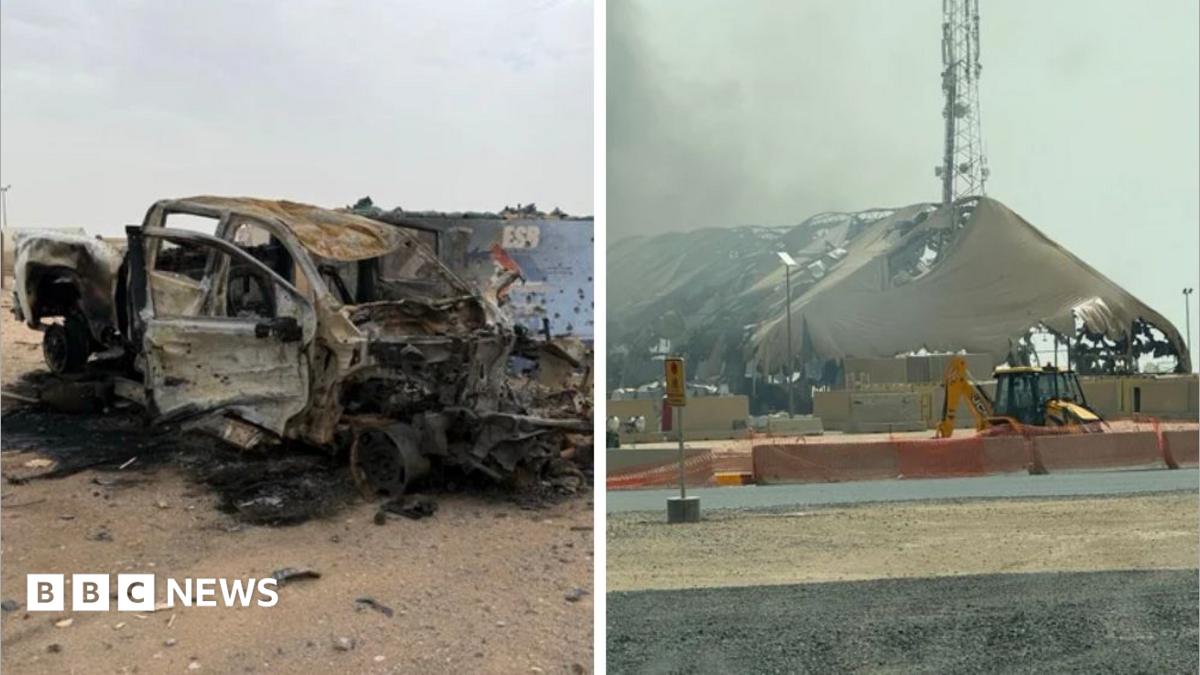
Newly disclosed photographs obtained by American broadcaster CBS have revealed the extensive scale of destruction inflicted on multiple United States military installations across the Middle East as a result of Iranian strikes. The imagery provides a rare and stark visual record of the physical toll sustained by American facilities during the conflict, highlighting significant structural devastation that had not previously been fully detailed to the public.
Supplied by active-duty military personnel, the undated collection of images documents severe destruction at American installations located in Saudi Arabia and Kuwait. The visual evidence illustrates a range of direct impacts, from flattened temporary living quarters and demolished multi-storey headquarters to heavily damaged military aircraft torn apart on air base tarmacs.
The release of the photographs has prompted sharp frustration from within the ranks. An unnamed military service member, speaking to CBS, expressed deep concern over the apparent gap between the reality on the ground and official disclosures, stating that substantial damage to US bases had not been clearly communicated to the American public. The personnel member characterized the vulnerable posture of the deployed forces by remarking that troops were effectively standing with their eyes closed while absorbing heavy blows.
When asked for a response regarding the leaked materials and the extent of the damage shown, the White House referred inquiries directly to United States Central Command. Centcom did not immediately provide a formal statement or comment on the photographs.
Among the most severe losses captured in the photographs is the wreckage of a Boeing E-3 Sentry aircraft at Prince Sultan Air Base in Saudi Arabia, situated roughly 62 miles (100 kilometers) southeast of the capital city of Riyadh. The imagery depicts the specialized early warning jet severed completely in half, with its tail assembly collapsed into a mangled heap of metal on the airfield.
The Boeing E-3 Airborne Warning and Control System (AWACS) represents a critical component of American aerial defence, utilizing long-range radar systems to track potential airborne threats and provide early warnings to allied forces. Although the specific date of the photograph remains unconfirmed, earlier visual analysis conducted by BBC Verify identified a similar image of the same downed radar jet dating back to March, when a US official confirmed to Reuters that an Iranian strike on the air base had wounded 12 American service members, two of them seriously.
Other photographs highlight severe ground destruction at Camp Buehring in Kuwait. One set of images shows rows of support trailers reduced to crumpled wreckage, alongside a large tent-like structure that was ripped to shreds while thick dark smoke billowed across the surrounding base perimeter.
Additional damage was documented at Camp Arifjan, another key American military installation in Kuwait. The photographs capture a four-storey base building that suffered major structural destruction from an Iranian projectile. This follows previous reports from March indicating that strikes in the vicinity of the camp had compromised critical facilities, including specialized satellite communications infrastructure.
The visual evidence of defensive shortfalls has drawn criticism from security analysts. Brian Katulis, a former national security official who served across both Democratic and Republican administrations and currently works as a senior fellow at the Middle East Institute, argued that the images demonstrate that the United States had failed to adequately prepare its base defences against incoming strikes.
Katulis further observed that substantial indicators suggest hostile global powers may have played an indirect role in facilitating the strikes. He noted that there is strong evidence that US adversaries, specifically China and Russia, may have assisted Iran with targeting intelligence, while criticizing the Trump administration for failing to take meaningful action to address and rectify these defensive vulnerabilities.
The emergence of the imagery coincides with the release of a comprehensive report from the Pentagon’s inspector general, which officially confirmed that Iranian bombardment damaged or demolished hundreds of buildings and structures across the region. The watchdog’s findings established that US facilities situated across eight separate nations—Kuwait, Bahrain, Qatar, the United Arab Emirates, Saudi Arabia, Iraq, Oman, and Jordan—sustained damage throughout the conflict.
According to the inspector general's audit, the overall financial cost of the war effort to the United States reached $33.4 billion (£24.7 billion) through June 29. Within that total, military equipment losses alone accounted for approximately $3.7 billion (£2.8 billion), with dozens of American aircraft damaged or completely destroyed during the initial months of the war, including five refuelling planes destroyed on the ground by Iranian munitions in Saudi Arabia.
A parallel evaluation released by the Congressional Budget Office (CBO) offered further insight into the fiscal and logistical hurdles created by the attacks. The CBO estimated that total equipment lost in combat—encompassing aircraft, unmanned drones, and a Terminal High Altitude Area Defense (THAAD) battery—amounted to roughly $1.9 billion (£1.4 billion).
The CBO report emphasized that replacing advanced assets like the destroyed E-3 Sentry presents unique challenges, as the airframe is no longer in active production and carries an individual valuation of $500 million (£371 million). Consequently, the military will be forced to procure more modern replacements, such as the E-7, to restore lost long-range radar capabilities.
The budgetary analysis was accompanied by caveats regarding official transparency. The CBO highlighted that its conclusions were subject to uncertainty because the Department of Defense failed to respond to requests for detailed information, compelling analysts to rely on public reporting and existing government databases while leaving the military's broader reconstruction plans unclear.
Katulis concluded that the financial and hardware toll underscores a severe depletion of vital American defence assets under the Trump administration without yielding substantial strategic gains, leaving lasting questions over regional security preparedness and base protection.






Comments (0)