 yoga-mahendra
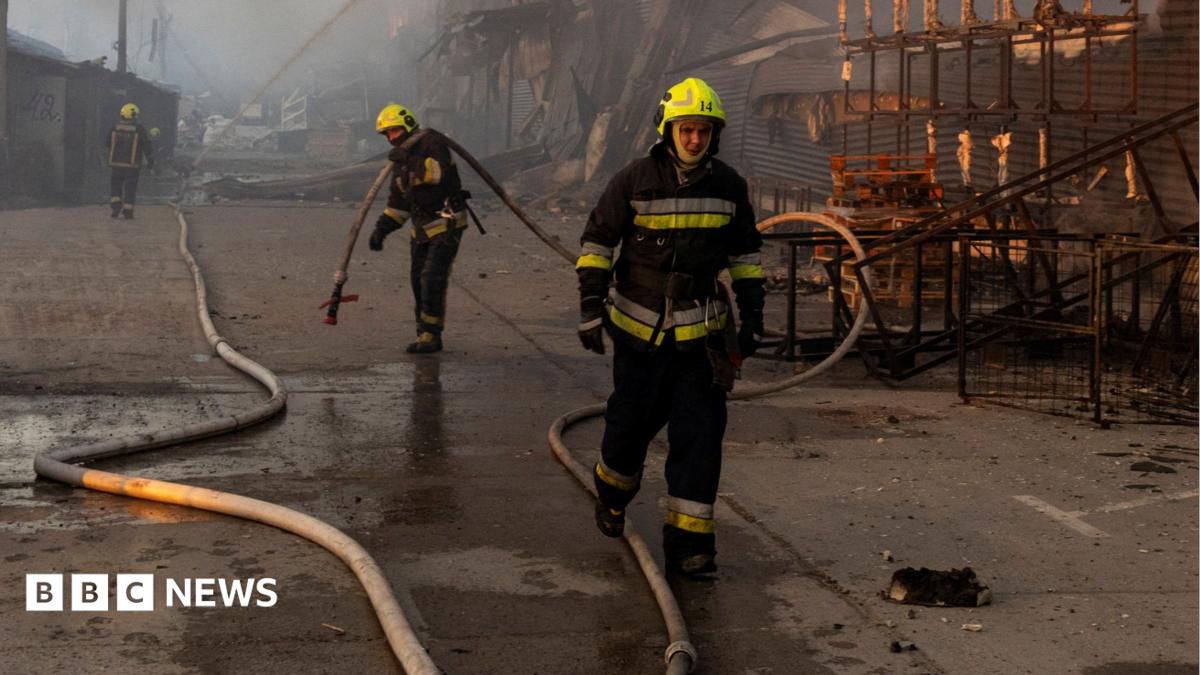
At least 15 people have been killed in a wave of overnight missile and drone attacks targeting central and eastern Ukraine, in what President Volodymyr Zelensky characterized as one of Russia's most "vile" assaults since the war began. The strikes, which unfolded across multiple regions, hit residential neighborhoods and critical infrastructure, leaving a trail of destruction that Ukrainian officials say was deliberately timed to coincide with Russian President Vladimir Putin's 74th birthday on Wednesday.
In the town of Pryluky, located in the Chernihiv region north of Kyiv, a five-story apartment building was reduced to rubble. Zelensky described the destruction as a macabre "birthday 'gift' to Putin," underscoring what he portrayed as the Kremlin's callous disregard for civilian life. Initial reports from the president indicated five people had been killed and 26 injured in Pryluky, including five children. By Wednesday morning, Chernihiv Oblast police confirmed the death toll had climbed to nine after the bodies of three children were recovered from the debris. Emergency workers continued digging through the collapsed structure amid fears that more residents remained trapped beneath the ruins.
The attacks were not confined to a single location. Strikes were reported in Kyiv, Dnipro, Kremenchuk, Zaporizhzhia, and Oleksandriya, painting a picture of a coordinated, large-scale operation spanning hundreds of kilometers. In Dnipro, missile strikes damaged five apartment buildings, killing two people and injuring eight others, according to Zelensky. Four high-rise buildings were hit in Kremenchuk, while two fatalities were reported in the capital, Kyiv, and another two in Oleksandriya. The geographic spread of the assault suggested a deliberate effort to overwhelm Ukraine's air defense systems, which Zelensky acknowledged managed to intercept only "some" of the incoming projectiles.
Ukraine's air force and allied analysts later assessed that Russia fired approximately 70 missiles during the overnight barrage, a figure cited by Zelensky in a social media post on Wednesday morning. The president renewed his urgent appeal to Western allies for expanded air defense support packages, arguing that the strikes exposed critical gaps in Ukraine's ability to shield its cities and energy infrastructure. "The Russians wanted to strike painfully and demonstratively," Zelensky wrote, framing the attack as both a military operation and a psychological assault aimed at demoralizing the Ukrainian public as winter approaches.
Among the most striking developments was the discovery of an unexploded Russian Iskander missile in a Kyiv district. Ukraine's national police published photographs showing the intact weapon lying in an open area surrounded by high-rise apartment buildings. BBC Verify confirmed the images were genuine and that the apparent missile fragments landed in a populated urban zone, raising questions about the failure rate of Russian munitions and the sheer luck that prevented additional casualties. A separate police video depicted rescue workers and civilians digging through the collapsed remains of a residential building in Pryluky, while another verified video showed damaged cars, rubble, and a fallen tree in Kremenchuk, where apartment blocks sustained significant damage.
Zelensky identified Ukraine's energy infrastructure as one of the "key targets" of the overnight assault. Moscow had previously signaled its intention to intensify strikes on Ukrainian power facilities in retaliation for Ukraine's own attacks on Russian energy sites. The targeting of energy infrastructure aligns with a broader Russian strategy observed throughout the war: attempting to cripple Ukraine's power grid ahead of the winter heating season, thereby exerting pressure on civilians and straining government resources. Ukrainian officials have consistently condemned such tactics as a form of collective punishment, while Moscow has framed them as legitimate military objectives.
In a separate statement on Wednesday, Zelensky claimed that Ukrainian forces had struck four targets in retaliatory attacks over the past 24 hours. These included two oil facilities and a military training ground in Russia's Perm, Samara, and Astrakhan regions. "There is also a response in the Black Sea," the Ukrainian president wrote, without elaborating further. The reference to the Black Sea appeared to acknowledge a series of escalating maritime incidents that have drawn international attention in recent days.
On Tuesday evening, footage emerged showing a massive plume of smoke billowing from an oil tanker off the coast of Sochi, a Russian resort city on the Black Sea. Russia's transport ministry later stated that unmanned boats had attacked the Liberian-flagged Aframax Rio oil tanker, claiming that the crew had been rescued. The incident marked another flashpoint in the increasingly contested waters of the Black Sea, where both military and civilian vessels have come under attack.
The maritime tensions extended beyond Russian waters. Bulgaria has halted its search for the missing crew of a ship that sank after being struck by a drone on Tuesday, according to Vice-Admiral Rumen Nikolov of the Maritime Administration Executive Agency, as reported by Bulgarian television network Nora TV. Tracking data indicated that the vessel, identified by the Bulgarian specialist news outlet Maritime.bg as the Alfa Watan, had been anchored at the southern end of the Bosphorus strait until Monday, when it entered the Black Sea heading north. Its last reported position on the ship-tracking site MarineTraffic was at 23:43 GMT on Monday, within Bulgaria's exclusive economic zone. Maritime.bg reported that the Alfa Watan was attacked by a drone and sank approximately 70 nautical miles (130 kilometers) east of Byala.
Bulgarian Prime Minister Rumen Radev disclosed on Tuesday that a second vessel carrying grain had also been struck within the country's exclusive economic zone. All 18 crew members aboard that ship were rescued. Bulgaria has not publicly attributed responsibility for the attacks, though Zelensky claimed in his Tuesday evening address that Russia was responsible. Moscow has not commented on the incidents, maintaining its customary silence on operational matters in the Black Sea.
The strikes and counter-strikes underscore the increasingly complex and multi-front nature of the conflict, which has now entered its third year with no clear end in sight. Russia's intensified campaign in the Black Sea, particularly along its eastern corridor, appears designed to disrupt Ukrainian grain exports and threaten commercial shipping, a strategy that carries significant implications for global food security. Meanwhile, Ukraine's retaliatory strikes deep inside Russian territory—targeting oil facilities and military infrastructure—demonstrate Kyiv's growing capacity to project power beyond its borders, albeit with limited resources compared to its adversary.
International observers have noted that the timing of the overnight attacks, coinciding with Putin's birthday, may have been intended as a symbolic message of Russian resolve. However, the civilian toll and the destruction of residential buildings in Pryluky, Dnipro, and Kremenchuk are likely to reinforce Ukraine's narrative of victimhood and galvanize support among Western allies. Whether that support will translate into the accelerated delivery of air defense systems—a persistent Ukrainian demand—remains an open question. For the residents of the affected cities, the immediate reality is one of grief, displacement, and the grim task of rebuilding amid an unrelenting war.









Comments (0)