 yoga-mahendra
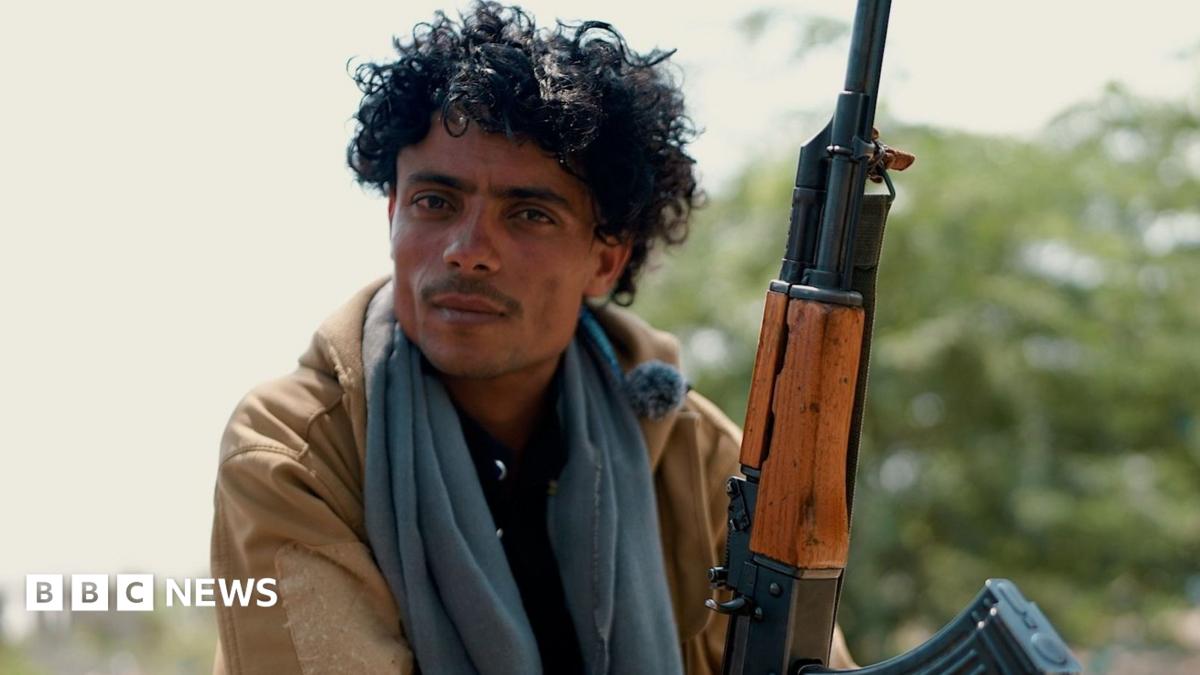
A soldier escorting BBC crews through the hills south-west of Taiz glanced up at the drone buzzing overhead and offered a grim prediction: it was only the first of its kind, and an attack would normally follow. The team took cover beneath low bushes until the aircraft passed, then climbed back into the vehicle and drove on. Within roughly ten minutes, the heavy thuds of airstrikes or bombardment came rolling down the mountainside, one detonation after another, with no clear indication of where they had landed.
The warning captured the situation around Yemen's third-largest city, where Saudi-backed government forces are trying to push back Houthi fighters. The group has swept south along the Red Sea coast in recent weeks, seizing a key shipping chokepoint and reviving a civil war that had been largely frozen for years. To understand what the fighting looks like at ground level, the correspondent travelled with government troops from Taiz through a series of checkpoints to the point where their authority ends and no man's land begins.
Finding that boundary is not straightforward. In the mountains south-west of the city, the slopes are dotted with homes, many of them abandoned after residents fled to escape the shelling. The road is empty in a way that a city of nearly a million people should never be: the constant stream of cars and motorbikes that normally thrum through Taiz has stopped, leaving behind only the bleating of livestock and the crackle of incoming and outgoing fire.
One man refused to abandon his home. Ali, who gave only his first name because he fears retribution if the Houthis advance, sits outside his property about a kilometre from the front line with a herd of goats and the memory of two mortar rounds that landed on his land. He has sent his children to a displacement camp, he said, because the shelling and gunfire had become unbearable for them, but he has stayed behind with his wife and sisters to care for the animals. He is terrified, he explained, but sees no alternative: without the goats, the family would starve regardless.
His account offers a grim measure of how deeply the front has moved into civilian life. The presence of livestock keepers, families and abandoned homes suggests lines that were drawn through inhabited terrain rather than empty desert, with the burden of the conflict falling on people who have nowhere further to run. Residents near the fighting have been placed in the position, described by aid workers in similar conflicts, of choosing between displacement and the loss of their livelihoods.
Behind the lines, both sides appear to be preparing for a further escalation. Contacts on the Houthi side told the BBC that fighters were consolidating their troops for a major offensive. Government commanders, asked about the claim, said they were aware of the threat and were making their own preparations — an admission that neither side expects the current standoff to hold for long.
At the checkpoint closest to the front, soldiers who had just come down from positions held a few hundred metres from advancing Houthi fighters spoke of the human cost of the terrain. The body of 18 government soldiers lay in an area within firing range of their unit but beyond any possibility of recovery, one fighter said. They can fire over the position, he explained, but they cannot reach it to recover the dead — a stark illustration of how a front line defined by high ground can freeze entire units in place.
The fighting has intensified particularly since the Houthis seized the strategic Red Sea port of Mokha, 85km west of Taiz, on 10 September, a move that effectively unpicked a ceasefire which had held, in large part, for four years. Along with Mokha, the group took a swathe of high ground overlooking the Bab al-Mandab Strait, the narrow waterway that serves as a vital shipping corridor between Europe and Asia. Control of that terrain has global consequences: fears of disruption to regional supply routes contributed to a rise in oil prices.
Taiz's strategic value lies in its geography. The city is Yemen's cultural capital and sits at a vital junction between Houthi-controlled territory to the north and government-held areas to the south, with front lines pressing in from several directions. Government forces hold the centre of the city, while Houthi positions lie to its north and east. Some of the fiercest recent fighting has taken place on the western approaches, where both sides are contesting elevated ground overlooking the main route south out of the city.
The stakes of that battle are straightforward for the government side. If the Houthis consolidate their hold on the western highlands, government forces could find it far more difficult to retake Mokha and undo the damage done to their position along the coast. Mapping by the Institute for the Study of War and AEI's Critical Threats Project, published in late September, shows Houthi control extending across much of western Yemen, including the capital Sanaa, and running south towards the strait, with contested ground marked along the edges of that territory and around Taiz itself.
The fragmentation on the government side is visible from the road. The BBC team reached Taiz from Aden, where Yemen's internationally recognised Presidential Leadership Council is based, counting roughly 30 checkpoints along a single route. Each marked territory held by a different commander — a sign of how fragmented and localised the forces arrayed against the Houthis have become.
Approaching the city, ambulances began to overtake the convoy. At least five passed within half an hour, all heading towards Taiz's main hospital, evidence of a steady flow of casualties that official figures rarely capture. The city itself has not shuttered: shops were lit, restaurants full and children playing in the streets after dark. But the ordinary noise of life was repeatedly punctured by the thud of shelling and the crack of gunfire from the surrounding mountains.
For now, Taiz endures that double existence — a functioning city ringed by a war that neither side shows any sign of ending. With both camps warning of preparations for a major offensive, the coming weeks on the ridges west of the city are likely to decide whether Mokha and the Bab al-Mandab approaches can be recovered, and how much further the front will push into the homes of Yemen's southwest.





Comments (0)