 yoga-mahendra
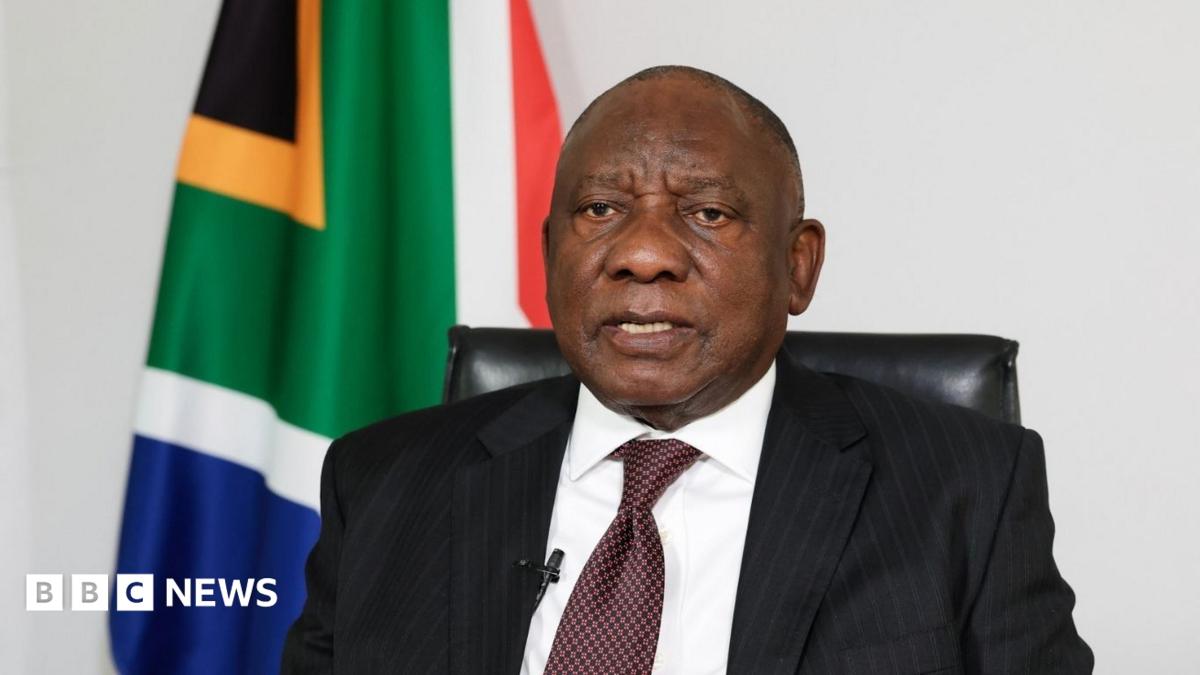
South African President Cyril Ramaphosa announced on Tuesday that the government will carry out a clean-up of high-risk areas across the country, following the discovery of the bodies of 12 women in a single area east of Johannesburg over two months. Speaking in an address to the nation, the president framed the measure as a targeted response to a localised tragedy that has become a national test of the state's commitment to women's safety.
The bodies were recovered in close proximity to one another in the same part of the country, a detail that triggered widespread public alarm. Ramaphosa acknowledged that fear directly, saying there had been "understandably been widespread fear that the discovery of these women in close proximity could indicate the work of a single perpetrator." He tempered that anxiety with a caution drawn from the police investigation: at present, investigators have not found evidence establishing that the killings were committed by one person.
The killings have sparked an outcry over the scale of violence against women in South Africa, a country the report notes has one of the highest rates of gender-based violence in the world. Ramaphosa said the government had not moved quickly enough to prevent such violence, admitting that the country has "not done enough" to protect women and girls. In unusually direct language, he said such violence "cannot be accepted as a normal part of life in South Africa" — a rhetorical position that implicitly acknowledges how entrenched the problem has become.
Beyond the environmental clean-up, Ramaphosa announced what he called a multidisciplinary, national-level emergency response to the murders. Four arrests have been made in connection with the killings, though the source material does not specify the charges or the suspects' status. The emphasis on a national-level, multi-agency response suggests the government is treating the case not simply as a local investigation but as a test of coordination between police, municipalities and other organs of state.
The centrepiece of the announcement is a new wave of preventive measures. "Every municipality must begin a women's safety audit without delay," Ramaphosa said, adding that high-risk areas "must be identified" and then addressed. He spelled out what such audits should look for: broken streetlights, overgrown public spaces, abandoned buildings, unsafe transport routes and facilities, and poorly secured parks — described collectively as "other conditions that place women at risk."
The logic of the audit programme is that risk is partly a product of the built environment. Poor lighting, neglected open ground and insecure buildings remove the visibility and escape routes that women rely on after dark, while dangerous transport corridors isolate passengers. By auditing municipal infrastructure against those criteria, the government is attempting to convert an abstract national statistics problem into a checklist that local authorities must complete and, presumably, be held to. The instruction to begin "without delay" and to cover every municipality signals an expectation that no local authority is exempt.
Ramaphosa also announced an "enforcement package" aimed at reducing alcohol-related violence, while being careful to reject the idea that alcohol explains or excuses such crimes. "Alcohol does not cause gender-based violence and it can never excuse it. Responsibility always lies with the perpetrator," he said. He nonetheless acknowledged that harmful alcohol use is a significant aggravating factor in interpersonal violence, and that it must be tackled as part of the broader prevention effort. That framing appears designed to forestall the widespread belief that individuals or victims are to blame for assaults committed while intoxicated, while still treating a common situational risk as a legitimate target for policy.
Beyond policing and legislation, the president argued that a deeper cultural shift is required. He said violence against women and girls "does not begin when a fist is raised" or when a woman is raped or murdered, but "much earlier" — in attitudes that treat women as inferior and that assume a man's right to control a woman. He extended the point to everyday distortions of feeling: "It begins when jealousy is mistaken for love, when control is mistaken for protection and coercion is mistaken for affection." And, he added, "It begins when a man refuses to accept the word no."
That reasoning led Ramaphosa to make a direct appeal to men and boys to take the lead in ending gender-based violence, rather than leaving the burden on women to avoid, report and survive it. "We have placed the burden of male violence on women. That must change," he said, adding: "The solution to violence against women cannot be to make women less free." The statement is significant in a context where one recurring policy response has been to restrict women's movement, working hours or use of public space.
The scale of the underlying problem sits behind the current measures. South Africa has one of the world's highest homicide rates, with 5,427 people murdered between April and June this year alone. Official police statistics do not break victims down by gender, a gap the president has not been able to close through enforcement figures alone. The South African Human Rights Commission recently reported that 569 women were killed and 1,052 others survived attempted murder over the same three-month period — meaning, for every woman who died in that window, close to two more were targeted and lived.
The coming weeks will test whether the audit programme produces tangible change. The clean-up commitment is within the government's gift, but identifying broken streetlights and abandoned buildings is a slower task than securing a high-risk stretch of road or arresting a suspect, and the four arrests made so far underline how much of the investigation remains open. Ramaphosa's own words set the benchmark: not merely punishing the men who committed these killings, but altering the conditions and attitudes that allowed them to occur. Whether municipalities move quickly enough — and whether the national emergency response produces visible results — will determine whether Tuesday's announcement is remembered as a turning point or as another set of promises unmet.







Comments (0)