 yoga-mahendra
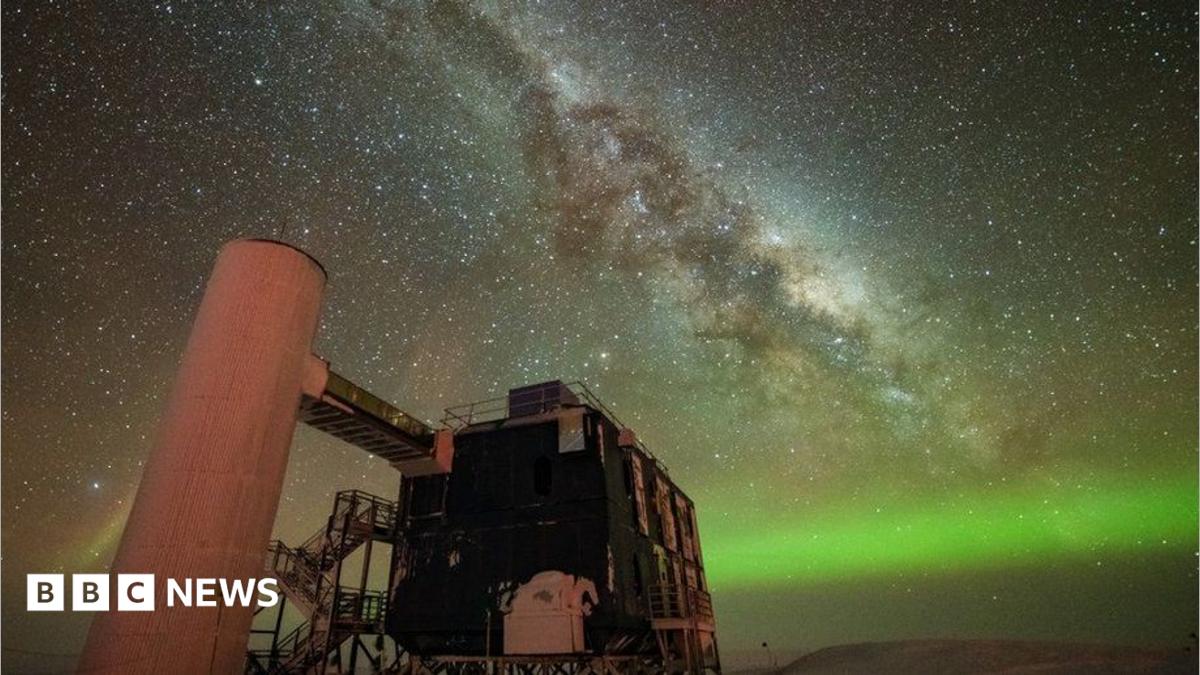
The Nobel Prize in Physics has been awarded to Belgian scientist Prof Francis Halzen for his foundational role in building an extraordinary observatory at the South Pole that captures elusive particles arriving from deep space. The Royal Swedish Academy of Sciences announced the award on 6 October 2026, recognising what it described as his "decisive contribution" to developing the IceCube Neutrino Observatory. The prize honours decades of work that has opened an entirely new window onto the universe.
Halzen's achievement rests on a remarkably ambitious idea: using a cubic kilometre of Antarctic ice, instrumented with light sensors, as a giant detector for particles known as neutrinos. These subatomic particles carry information about the most violent, high-energy processes occurring in the cosmos, and IceCube was designed specifically to catch them. The observatory represents a fusion of particle physics and astronomy on a scale rarely attempted.
The Royal Swedish Academy of Sciences praised Halzen's vision and leadership, stating that both have been fundamental to the IceCube project. The recognition reflects not merely a single discovery but the creation of an entire instrument and the scientific community built around it. Halzen's journey from proposing the concept to seeing it realised spans nearly four decades.
His first formal presentation of the idea to detect neutrinos at the South Pole dates back to 1988. At the time, the notion of burying sensors deep in polar ice to study astrophysical particles must have seemed highly speculative. Yet Halzen persisted, assembling an international team of researchers and engineers who would ultimately construct one of the most remarkable scientific instruments ever built.
Mark Pearce, Chair of the Nobel Committee for Physics, highlighted the scale of the collaboration behind the achievement. He noted that Halzen led an international team of researchers and engineers who provided the world with a fantastic instrument. Pearce also emphasised that Halzen's tenacity and scientific vision paved the way for a new kind of astronomy, one that relies on particles rather than light to study the universe.
Neutrinos are notoriously difficult to detect because they interact extremely weakly with matter. The Sun alone produces vast quantities of them, and every second billions pass harmlessly through an area the size of a human fingernail. This ghost-like quality is precisely what makes them both challenging and valuable to scientists seeking to understand cosmic phenomena.
However, IceCube is not primarily designed to study the relatively low-energy neutrinos streaming from the Sun. Instead, it hunts for far more energetic neutrinos produced by violent processes occurring well beyond our Solar System, in distant galaxies. These high-energy particles serve as astronomical messengers, pointing back to the fundamental events that created them.
The detection method relies on the rare occasions when a neutrino interacts with the ice rather than passing straight through. When such an interaction occurs, it produces secondary particles that emit a distinctive flash of light. IceCube's sensors, embedded throughout the Antarctic ice, are designed to capture these telltale signals.
Each of these rare light flashes carries valuable clues about the neutrino's origin and the extreme conditions that generated it. By analysing these signals, scientists can investigate environments that ordinary telescopes struggle to observe. This allows researchers to probe some of the most energetic and mysterious processes in the universe.
The implications of Halzen's work extend well beyond the detection of individual particles. IceCube has effectively established a new branch of astronomy, one that complements traditional observations made with light, radio waves, and other forms of electromagnetic radiation. Neutrino astronomy offers a unique perspective on the cosmos, revealing phenomena that would otherwise remain hidden.
The award also underscores the importance of long-term scientific vision and international cooperation. Building and operating a detector the size of a cubic kilometre in one of the most inhospitable environments on Earth required sustained commitment from many nations and institutions. Halzen's leadership was central to maintaining that momentum over many years.
Prof Halzen's career demonstrates how a single compelling idea, pursued with determination, can transform a field. His initial 1988 proposal was met with considerable scepticism, yet he continued to refine and advocate for the concept. The eventual success of IceCube stands as a testament to the value of persistence in fundamental research.
The Nobel Committee's decision to honour Halzen places him among the most influential physicists of his generation. His work has not only produced scientific results but has also created a lasting infrastructure for future discoveries. The IceCube Observatory continues to operate, collecting data that will fuel research for years to come.
As the scientific community celebrates this recognition, the prize also draws public attention to the broader field of particle astrophysics. The study of neutrinos from space remains a young and rapidly evolving discipline, with many questions still unanswered. Halzen's contributions have laid the groundwork for the next generation of researchers to explore.
The Nobel Prize in Physics for 2026 thus honours a scientist whose vision literally reached the ends of the Earth. By transforming a cubic kilometre of Antarctic ice into a sophisticated particle detector, Francis Halzen has given humanity a powerful new set of eyes with which to view the universe. His work ensures that the ghostly neutrinos travelling across space will no longer pass entirely unnoticed.





Comments (0)