 fitri-handayani
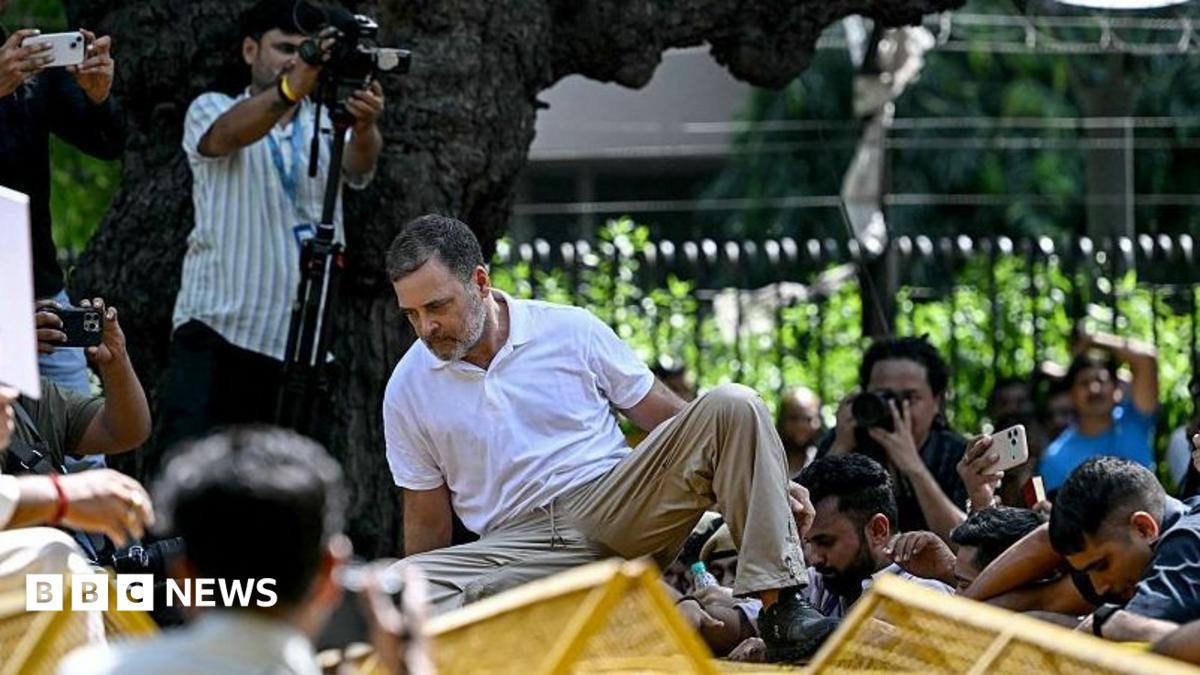
Police in India's capital detained multiple opposition lawmakers on Tuesday as they attempted to march on the Election Commission headquarters, escalating a fierce political confrontation over the government's nationwide revision of electoral rolls. Among those stopped were Rahul Gandhi, the leader of the opposition in the lower house of parliament, along with his sister Priyanka Gandhi Vadra and a host of other members of parliament from across the opposition spectrum. The lawmakers were intercepted by officers who had barricaded the route between parliament and the commission's offices, bundled into police buses and driven to various police stations before being released a short time later.
Undeterred by the detentions, the MPs regrouped and resumed their march, ultimately staging a sit-in near the Election Commission's headquarters. The opposition claimed that 237 parliamentarians from a range of parties took part in the demonstration, though police did not disclose how many lawmakers they had detained. Additional Deputy Commissioner of Police Manjeet Sheoran told the BBC that officers had been stationed at multiple points to prevent protesters from taking alternative routes to the commission building, describing how the demonstrators were "picked up in buses and taken to different police stations."
The confrontation marks the latest chapter in a rapidly intensifying dispute over the Special Intensive Revision (SIR) of electoral rolls, an exercise the Election Commission says is designed to purge duplicate and ineligible names from voter lists. The process began in the eastern state of Bihar in June 2025 and has since been expanded to other regions across the country. According to the commission, more than 130 million names have already been removed from draft voter lists nationwide — a figure that has alarmed opposition parties and civil society groups alike.
Opposition leaders argue that the revision is a thinly veiled attempt to disenfranchise millions of eligible voters, particularly those belonging to marginalised communities who may lack the documentation required to prove their eligibility. They accuse Chief Election Commissioner Gyanesh Kumar of steering a process that could disproportionately benefit Prime Minister Narendra Modi's Bharatiya Janata Party (BJP). Both the BJP and the Election Commission have categorically rejected these allegations, maintaining that the exercise is a routine administrative measure aimed at ensuring the integrity of the electoral process.
The demand for Kumar's resignation gained fresh momentum following an investigation by the Indian Express newspaper, which reported that the two other election commissioners, Sukhbir Singh Sandhu and Vivek Joshi, had formally objected at least 14 times over a 10-month period. According to the report, the commissioners protested against decisions and orders they said had been issued in the Election Commission's name without their knowledge. The objections reportedly touched on sensitive matters including additions and deletions from voter rolls, access to the voter database and the security of electoral data, with some concerns directly linked to the ongoing roll revision programme.
The Election Commission, a three-member body composed of the chief election commissioner and two fellow commissioners, has defended its internal decision-making, insisting that differing views are a normal part of institutional functioning and that all final decisions were ultimately taken unanimously. Nevertheless, the revelations have triggered a political firestorm, with opposition leaders redoubling their calls for Kumar to step down and accusing the government of eroding the independence of India's electoral machinery.
Congress president Mallikarjun Kharge outlined three demands he described as "non-negotiable": Kumar's resignation, the cancellation of the SIR exercise and a return to paper ballot voting. Rahul Gandhi, who was among those detained on Tuesday, mocked the election chief on social media, writing: "Gyanesh, it's done, bro. Time to resign." The opposition's push for paper ballots reflects long-standing concerns about the reliability and transparency of electronic voting machines, a debate that has periodically resurfaced in Indian politics over the past two decades.
The BJP responded forcefully to the protests, with party MP Sambit Patra condemning the demonstrations as a "sponsored attempt" to bring about a change of power through "anarchy." Patra accused opposition parties of seeking to undermine constitutional institutions, including the Election Commission, and characterised the agitation as an effort to delegitimise a process designed to clean up the electoral system. The governing party's counter-argument hinges on the claim that the opposition is unwilling to accept any measure that might reduce its electoral advantages.
The controversy has now reached India's Supreme Court, which has asked both the federal government and the Election Commission to respond to a petition alleging that Kumar took key decisions without the approval of his two fellow commissioners. The petition argues that Kumar exercised powers that properly belong to the commission collectively and seeks a ruling that any such actions were unauthorised. The court indicated that Election Commission decisions must be taken either unanimously or by majority vote, and suggested that decisions could be set aside if found to have bypassed that procedure — a signal that the judiciary may be prepared to scrutinise the commission's internal workings closely.
Tuesday's protest came just four days after the Cockroach Janta Party (CJP), a Gen Z-backed online satirical movement, organised demonstrations in Mumbai and Delhi that also demanded the CEC's resignation. The group has framed those rallies as the opening salvo of a nationwide campaign and has called for another round of protests on 10 October. The involvement of a youth-driven, internet-native movement underscores how the voter roll controversy has transcended traditional party politics, drawing in new actors and amplifying public anger through social media.
Security was visibly tightened around the Election Commission headquarters on Tuesday, with police erecting barricades along the route connecting parliament to the commission's office. The heavy security presence, combined with the detentions of sitting MPs, has raised questions about the balance between maintaining public order and respecting the right to protest in the world's largest democracy. Opposition leaders denounced the detentions as an attack on democratic expression, while authorities maintained that the restrictions were necessary to prevent disruption.
At the heart of the dispute lies a fundamental question about the credibility of India's electoral institutions. The Election Commission has long been regarded as one of the country's most respected constitutional bodies, responsible for conducting elections at a scale unmatched anywhere in the world. Allegations that its internal decision-making has become opaque or dominated by a single commissioner therefore carry particular weight, threatening to undermine public confidence in a system that millions of voters depend upon.
With the Supreme Court now scrutinising the commission's conduct, the opposition planning further protests and the CJP mobilising for another round of demonstrations, the standoff appears far from resolution. The coming weeks are likely to see intensified political pressure on Kumar and the commission, even as the BJP doubles down on its defence of the revision process. How India's institutions navigate this confrontation — and whether the voter roll exercise proceeds as planned — could shape the political landscape well beyond the current controversy.







Comments (0)