 yoga-mahendra
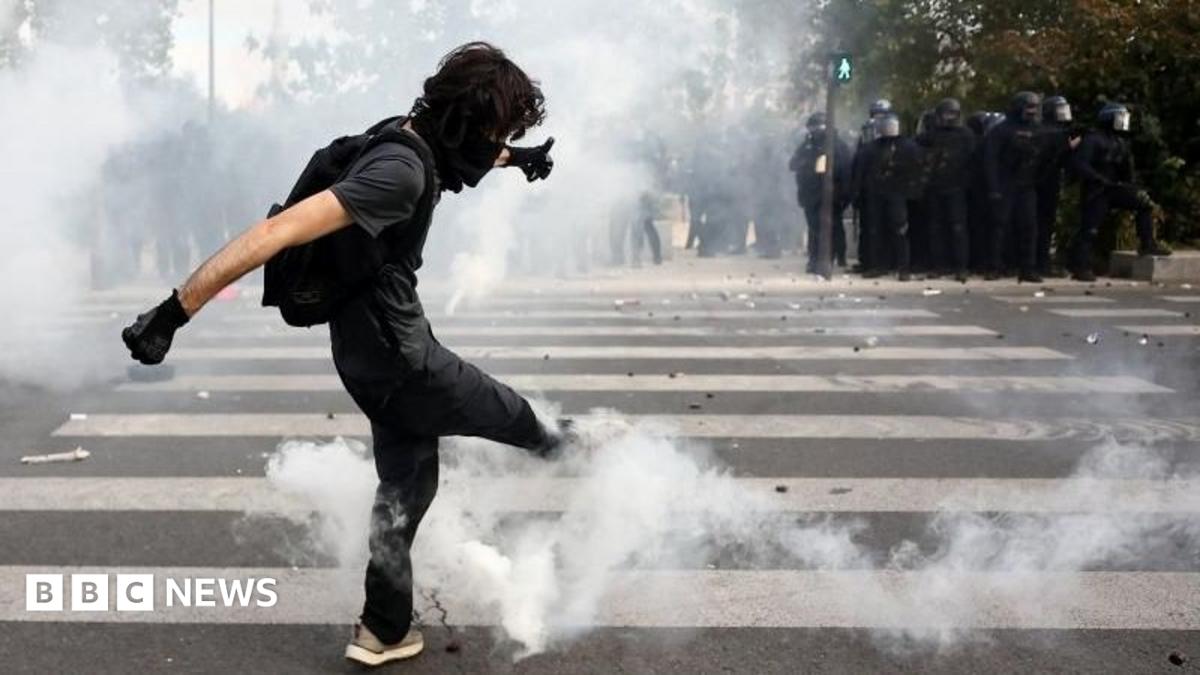
Hundreds of thousands of demonstrators flooded streets across France on Tuesday as a protest movement that began with high-school pupils expanded to include parents, university students and trade unions, prompting police to deploy tear gas in Paris and Marseille and water cannon in Rennes.
The unrest marks the latest phase of a campaign that started in mid-September in Seine-Saint-Denis, a deprived suburb north of Paris, where students and teachers voiced anger over overcrowded classrooms, a shortage of teaching staff and crumbling school buildings. What was initially local discontent has since snowballed into a nationwide phenomenon, with protesters now labelling Tuesday's action "Act Three" of their movement.
In the capital, crowds of teenagers marched from the Place de la République, demanding greater resources for schools and what they described as an end to heavy-handed policing. Similar scenes played out in Lyon, where officers clashed with demonstrators, while in Marseille thousands of protesters wound their way through the city, pausing to chant before moving on as police lines shifted.
The atmosphere in Marseille at times turned confrontational. A group of masked protesters seized bollards and bins in an attempt to build barricades separating themselves from riot officers, who responded by firing tear gas and dispersing the crowd. Yet the day's disturbances were markedly less severe than the serious trouble that marred earlier rounds of protest.
Prime Minister Sébastien Lecornu condemned the violence that has accompanied the movement, revealing that since the protests began, 215 students and 85 school staff have been injured, alongside 715 police officers. His comments came as the government sought to frame the unrest within a broader political context.
Addressing parliament, Lecornu accused the radical-left France Unbowed (LFI) party of attempting to "sow chaos" ahead of presidential elections due in seven months. The political backdrop is charged: President Emmanuel Macron is approaching the end of his second and final term, while LFI leader Jean-Luc Mélenchon currently trails only Marine Le Pen of the hard-right National Rally in opinion polls. Macron was expected to chair a meeting with ministers at the Élysée Palace on Tuesday evening to assess the unfolding situation.
The scale of the mobilisation remains disputed. The government said disruption had affected 891 high schools - nearly a quarter of all lycées nationwide - and estimated that more than 250,000 demonstrators had taken to the streets. Student unions, however, put the figure at 450,000 and claimed that 1,800 high schools had been blockaded.
Behind the statistics lie mounting concerns about police tactics. France's IGPN police inspectorate has been investigating multiple allegations of "disproportionate force". In one case, an officer who fired a tear-gas grenade at a high-school student in Saint-Ouen-l'Aumône, north-west of Paris, last week has been charged by prosecutors with violence resulting in mutilation or permanent disability.
The victim, 14-year-old Eden, was part of a group blockading the Château d'Épluches lycée, which serves students aged 15 to 18, when he was struck in the face. His lawyer said he sustained a fractured jaw, broken upper teeth and the loss of four lower teeth. The case has become a rallying point for those demanding accountability.
A separate incident on Monday in the northern city of Lens left a 15-year-old boy with his hand torn off after a so-called anti-encirclement grenade was fired under circumstances that remain unclear near a school. Authorities maintain the teenager picked up the "sting ball" grenade and it exploded in his hand, while students allege he was hit directly after an officer fired it. The device is officially classified as a non-lethal weapon. The local prefect said the incident occurred when police were confronted by a group of 200 to 250 students throwing stones and fireworks.
Education Minister Édouard Geffray said he had from the outset appealed for dialogue rather than blockades, and complained that "ultra-violent elements infiltrated the high-school student movements". He now faces intensifying pressure to address the students' demands. Measures offered so far - including a website for students to air grievances and an afternoon of internal discussion in schools scheduled for Friday - have done little to quell the anger.
On the ground, protesters describe conditions that they say make learning nearly impossible. Alissa, a student in Marseille, insisted that most demonstrators were not violent. "We're going to the streets because they've closed our schools... schools are falling apart," she said. Her friend Sacha added that ceilings in Marseille's schools were leaking and conditions were generally poor, meaning "we can't really work a lot of time". He vowed: "We will keep doing this until good measures are taken."
There appears little prospect of the movement fading soon. The CGT, France's largest trade union, has announced that further protests involving both school and university students are being planned for Thursday, signalling that the campaign's organisers intend to maintain momentum and broaden their pressure on the government.






Comments (0)