 yoga-mahendra
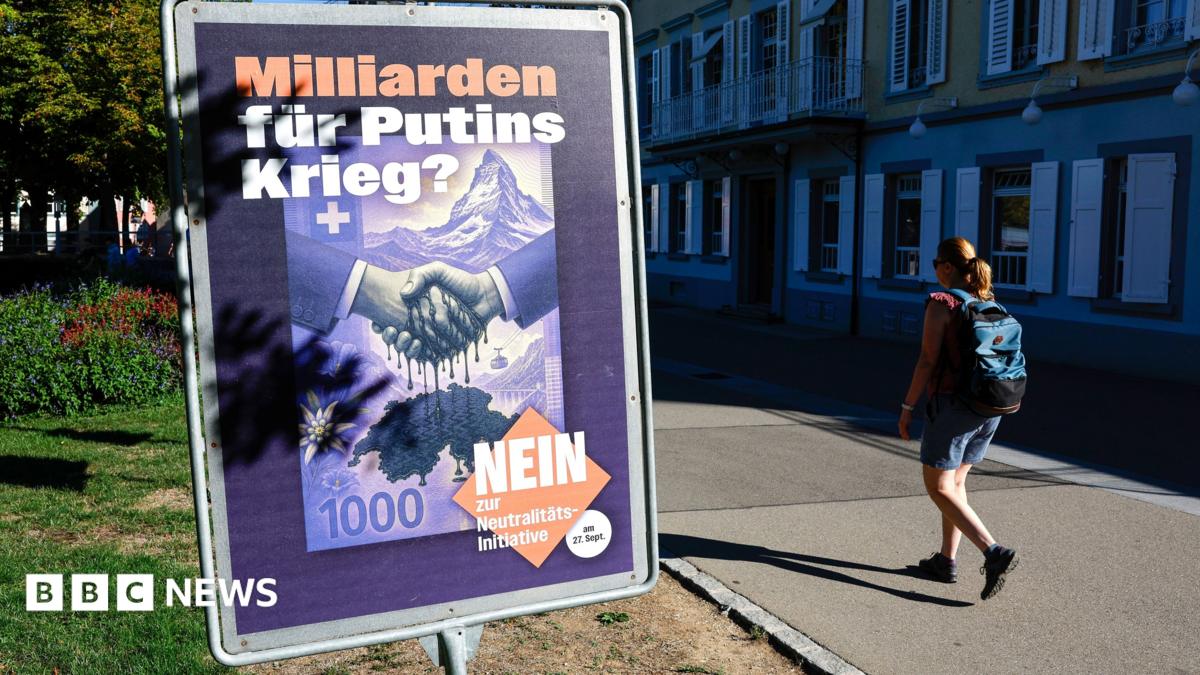
Swiss voters have decisively rejected an attempt to harden the country's long-standing tradition of diplomatic neutrality into a stricter legal rule. Official results showed that more than 70% of those voting said no to the "Neutrality Initiative", a package of proposals that would have required Switzerland to obtain United Nations authorisation before imposing sanctions on any country, and that would have ruled out drawing closer ties to the Nato military alliance.
The campaign drew unusually direct interest from abroad. Moscow openly backed the initiative, which was championed domestically by the right-wing Swiss People's Party (SVP) and opposed by the federal government and every other major party in the country. The result is therefore widely read less as a referendum on Swiss values in the abstract than as a verdict on how far Bern should go in confronting Russia following Moscow's full-scale invasion of Ukraine — a war that has sharply reopened a debate most Swiss leaders had hoped to keep closed.
Analysts caution against reading the outcome as a repudiation of neutrality itself. Lukas Golder, co-director of the research institute Gfs.bern, told Swiss public broadcaster SRF that voters had not rejected the idea of Switzerland remaining neutral. In his reading, the vote instead demonstrated public support for sanctions against Russia, and a public understanding of what neutrality is meant to achieve in practice. "People have a clear idea of what Switzerland's neutrality is supposed to achieve," he said.
That distinction matters, because Swiss neutrality has never been a rigid absolute. Foreign Minister Ignazio Cassis made the same argument during a televised debate ahead of the vote, noting that "neutrality has always been applied with a degree of flexibility". The government's position was that the tradition exists to serve a purpose — keeping Switzerland out of conflicts and a channel for dialogue — rather than as an end in itself. Voters appear to have accepted that framing.
The government nonetheless drew a firm line on one area. Bern has no plans to lift its prohibition on selling arms to countries engaged in conflict, a restriction that would continue to apply to Ukraine. But Cassis argued that "neutrality does not mean indifference", and said Switzerland would "not look away when we see violations of the very international rules that allow us to live in peace." The position reflects a long-standing Swiss view: participation in sanctions and arms-embargo regimes is compatible with neutrality, while military alliances and arms exports are not.
The legal architecture behind that position is old. Switzerland's status was internationally recognised in 1815, when the country was granted "eternal neutrality" at the Congress of Vienna, amid a period of war and upheaval across Europe. Its scope was later defined by the Hague Convention of 1907, which forbade the supply of weapons to countries at war. That legal limit has proven binding in recent years: Switzerland previously turned down a request from Germany for ammunition for tanks bound for Kyiv.
The history behind the tradition is considerably darker than the word "neutrality" suggests. Switzerland remained neutral throughout the Second World War, but neutrality came at a cost. The country accepted and banked gold looted by the Nazis, and, in a move calculated to discourage an invasion by Nazi Germany, turned away thousands of Jewish refugees at its border. Swiss authorities apologised for those policies in the 1990s, a reckoning that continues to shape how the country talks about its own past.
Against that background, the referendum result arrives in a political system with few parallels. Switzerland's system of direct democracy means major policy questions are routinely deferred to the electorate through referendums, allowing a single vote to redraw the terms of a core national doctrine. Campaigners on both sides framed the choice in stark terms: either a neutral state that acts in concert with the international community, or one whose hands are tied by its own history.
The rejection of the initiative leaves Swiss policymakers with a degree of room, but not unlimited freedom. Sanctions adopted at European Union level continue to apply, and public support for measures targeting Russia remains evident. The government's own framing suggests it will continue to act alongside partners while formally staying outside alliances and retaining its arms-export ban.
For the SVP, the defeat is significant. A party that has long argued for closer alignment with Nato and for a tougher posture towards "foreign interests" failed to persuade a majority of the electorate that neutrality should be narrowed. The government's argument — that flexibility has always been part of the tradition, and that defending international rules serves neutral Switzerland's own interests — appears to have carried voters with it.
Analysts such as Golder suggest the deeper significance lies in what the public understands neutrality to be for. If neutrality is judged by its usefulness in securing peace and enabling the country to act as a mediator, then measures that do not compromise those goals are likely to remain acceptable. Proposals to entrench the doctrine in law, by contrast, are likely to keep failing unless they are paired with a security rationale that voters find compelling.
For now, the immediate question of whether Switzerland sanctions without UN backing has been settled — at least for the moment. The deeper debate, about what a neutral state owes to an international order it says it values, is likely to return to Swiss voters in some form, and Swiss democracy guarantees it will be put to them again.





Comments (0)