 yoga-mahendra
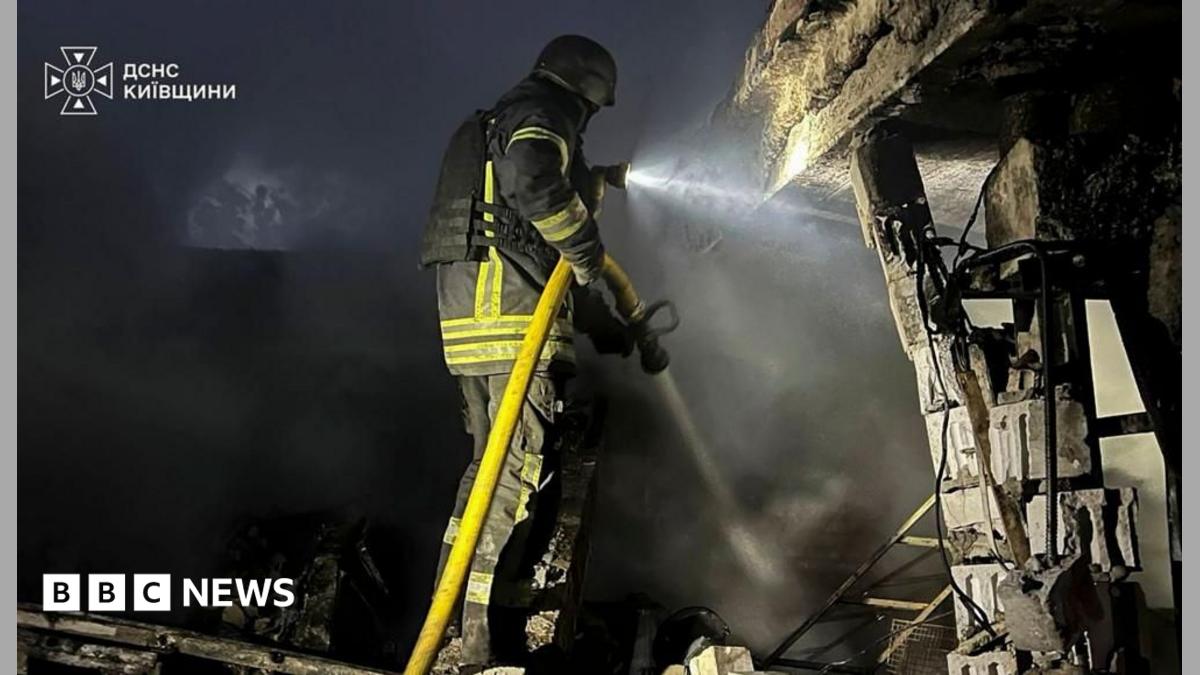
Russia has carried out its most extensive assault on Ukraine's energy infrastructure in months, according to Ukrainian Prime Minister Serhiy Koretskyi, with the capital Kyiv and its surrounding region bearing the brunt of the overnight bombardment. The attacks mark a significant escalation in Moscow's campaign against Ukraine's power network and raise fresh concerns about the country's ability to keep the lights on as another wartime winter approaches.
Local authorities confirmed that at least six people lost their lives and 33 others sustained injuries in strikes across the country. Among the dead was a child, whose body was recovered from beneath the rubble of a destroyed house in the Kyiv region, according to regional governor Timur Tkachenko. The toll underscored the human cost of the assault, which affected civilian areas far beyond military targets.
Kyiv Mayor Vitaly Klitschko reported that three people were killed in the capital itself, including an employee of a Ukrainian utility company who died when a warehouse building was hit. It remained unclear whether the child counted among the fatalities in the wider Kyiv region was included in the mayor's figure. In the north-eastern Sumy region, governor Oleh Hryhorov said two more people died, while acting regional governor Heorhiy Reshetilov confirmed a further death in the Mykolaiv region.
The scale of the attack extended well beyond the capital. Koretskyi stated that 11 regions across Ukraine came under fire overnight, with residential buildings, social infrastructure, civilian enterprises and railway facilities among the targets. President Volodymyr Zelensky separately identified strikes on critical infrastructure in the Zhytomyr, Mykolaiv, Kirovohrad and Rivne regions, illustrating the breadth of the assault.
Ukraine's energy system felt the impact almost immediately. DTEK, the country's largest private energy company, described "a difficult night" for Kyiv and said power had been restored to 8,000 homes following outages. By Wednesday, households in the Kyiv, Dnipropetrovsk, Donetsk, Sumy and Kharkiv regions were still without electricity, according to the energy ministry. State grid operator Ukrenergo urged residents to avoid using high-powered electrical appliances between 10:00 and 16:00 local time because supplies were running below normal levels.
The Russian defence ministry claimed one of its targets was the Trypilska power station, described as the largest supplier of electricity to Kyiv. Ukrainian officials have not confirmed that specific claim, and the discrepancy highlights the difficulty of independently verifying battlefield assertions during the ongoing conflict.
In his statement on Telegram, Koretskyi framed the attack as a departure from the pattern of recent months. "Since the summer, there has effectively not been a single day without enemy attacks on our energy infrastructure," he said. "However, a mass and combined attack of this scale has occurred for the first time since the end of the last heating season." His words pointed to a deliberate shift in Russian tactics, concentrating multiple weapons systems against the grid in a single coordinated operation.
The assault did not come as a surprise to Ukrainian authorities. Officials had been anticipating another prolonged Russian campaign against the country's energy network, a strategy Moscow has employed every winter since its full-scale invasion in 2022. The approach appears designed to deprive civilians of heat, water and electricity during the coldest months, straining morale and testing the resilience of Ukraine's emergency services.
In Kyiv, residents woke to a city shrouded in thick, acrid smoke after a night punctuated by explosions. An air raid alert remained in force, and the distant sound of air defence gunfire echoed through the murky atmosphere. Authorities advised people in several districts to keep their windows closed until the smoke dissipated. The haze, captured in photographs showing grey plumes hanging over the capital, served as a visible reminder of the previous night's violence.
The human and psychological impact of such strikes extends beyond immediate casualties. Repeated attacks on power generation and distribution force families to cope with darkness, disrupted communications and the loss of heating, while hospitals and other essential services must rely on backup systems. Each new barrage also imposes growing repair costs on a energy sector already battered by years of war, complicating efforts to restore capacity before temperatures drop further.
Moscow's targeting of energy infrastructure has drawn widespread international condemnation in the past, with allies of Kyiv describing it as a campaign aimed at civilian life. Russia, for its part, has consistently framed such strikes as legitimate attacks on infrastructure linked to Ukraine's military capabilities, even when the facilities involved primarily serve civilian needs.
The broader context remains one of entrenched conflict. Russian President Vladimir Putin launched his full-scale invasion of Ukraine in 2022, and Moscow currently controls roughly 20% of Ukrainian territory. With no sign of a negotiated settlement, both sides continue to trade long-range strikes, and Ukraine has itself carried out drone attacks deep inside Russia in recent months, including what Moscow's mayor described as the largest attack on the capital.
For Ukraine, the latest assault reinforces the urgent need for strengthened air defences and spare parts for its power grid. Western partners have supplied various systems to intercept missiles and drones, but the volume of incoming fire means some always get through. Officials have warned that protecting every facility across such a large country is impossible, leaving energy workers to carry out dangerous repairs under the constant threat of further attacks.
As emergency crews continued to clear debris and restore services on Wednesday, the immediate priority was restoring power to affected households and confirming the full extent of the damage. But with winter approaching and officials expecting more attacks, the strikes served as a stark signal that Ukraine's energy infrastructure will remain a central front in the war, with consequences measured not only in megawatts lost but in lives disrupted across the country.









Comments (0)