 yoga-mahendra
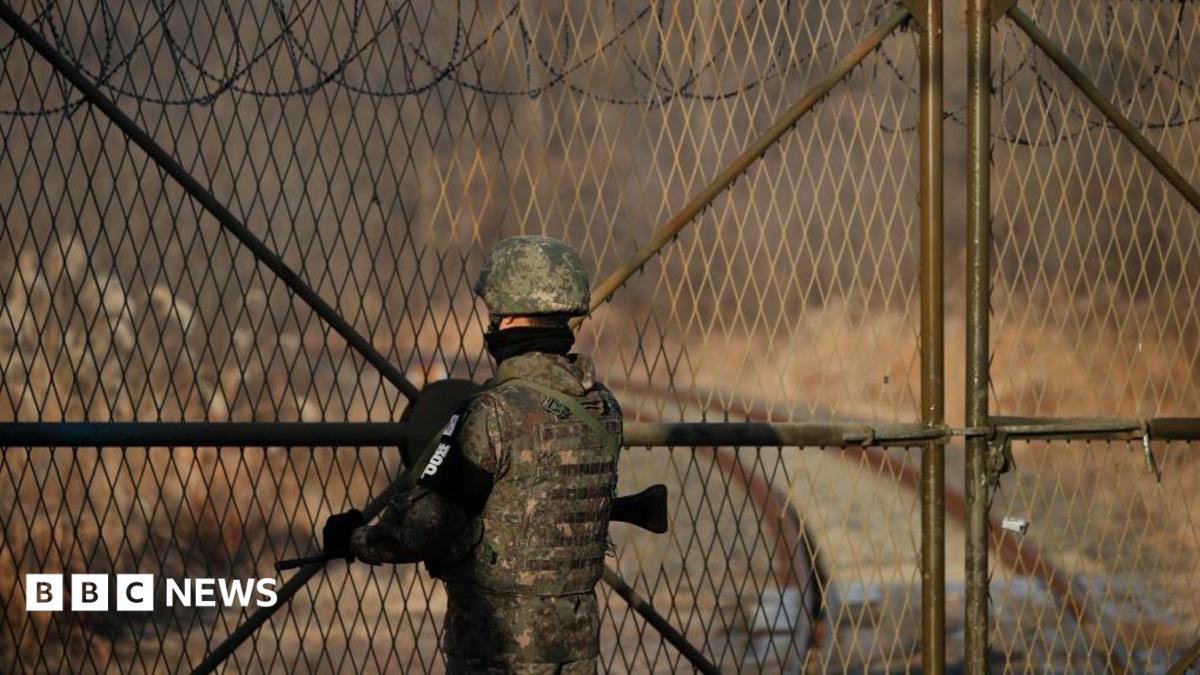
South Korea's military has formally demanded that North Korea issue an apology for landmine explosions along the two countries' shared border that left three South Korean personnel wounded earlier this month, according to statements released this week.
The explosions occurred on 21 September inside the Demilitarised Zone (DMZ), the heavily fortified buffer strip that has separated the two Koreas since the end of active fighting in the Korean War. South Korean authorities say the blasts took place on their side of the demarcation line.
On Tuesday, South Korea's military said the explosions were "highly likely" caused by North Korean mines, and vowed to take "corresponding measures" over what it described as a violation of the decades-old armistice agreement that ended open combat in 1953.
The armistice established the roughly 4km-wide (2.5mi) DMZ, a buffer zone bisected by the Military Demarcation Line, which serves as the de facto land border between the two nations. Despite the truce, the area has remained a flashpoint for sporadic clashes, mine detonations and other incidents over the intervening decades.
In a statement issued Wednesday, South Korea called on Pyongyang to apologise for the blasts and to immediately halt what it described as fortification activities along the border. Seoul believes the mines were planted by North Korean forces to reinforce their side of the frontier.
North Korea has flatly rejected responsibility for the explosions, dismissing Seoul's allegations as "groundless" and characterising them as a "farce" designed to inflame tensions on the peninsula.
Kim Yo Jong, the influential sister of North Korean leader Kim Jong Un, accused South Korea of "cooking up" the claims to serve what she called "political and military provocation." In a statement carried by state media on Wednesday, she denied that North Korean personnel had crossed the border to lay mines.
Kim described Seoul's assertions as "a deliberate and planned strained assertion to shift the responsibility for escalating tension" onto Pyongyang. She also issued a warning, saying the South should be "prepared for paying price for the farce of their own making."
The exchange marks the latest escalation in a war of words between the two Koreas, which technically remain in a state of conflict since the 1950-53 Korean War ended in an armistice rather than a peace treaty.
South Korean Defence Minister Kang Shin-chul said Tuesday that the blasts represented a "clear" violation of the 1953 armistice. His remarks underscored Seoul's position that the incident crossed a legal and military threshold, not merely a security breach.
The United Nations Command (UNC), which conducted on-site investigations into the explosions alongside the South Korean military, said it would address the armistice violation "through established Armistice mechanisms." The UNC, which oversees the truce framework, added that it "remains committed to maintaining and enforcing the Armistice Agreement and fulfilling its responsibilities to preserve stability and prevent escalation on the Korean Peninsula."
The incident echoes a similar episode in 2015, when two South Korean soldiers were maimed by landmines while patrolling the DMZ. At the time, Seoul said the devices had been secretly planted by North Korean soldiers near a South Korean guard post — a claim Pyongyang denied.
Kim Yo Jong referenced that 2015 incident in her Wednesday statement, arguing that South Korea had used it as a "pretext" to escalate tensions and was now repeating the same playbook. Her remarks suggest Pyongyang views the current allegations through the lens of historical grievances and perceives Seoul's response as part of a broader pattern of provocation.
The timing of the blasts and the ensuing diplomatic row add fresh strain to an already fragile security environment on the Korean Peninsula. The DMZ, despite its name, has long been the site of military buildups, propaganda broadcasts and periodic firefights, and any incident there carries the risk of rapid escalation.
Analysts note that both Koreas have used border incidents to signal resolve and rally domestic support, and that the current exchange follows a familiar script: an incident occurs, each side accuses the other of aggression, and the UNC is drawn in to adjudicate. What remains unclear is whether the latest confrontation will remain rhetorical or lead to concrete military or diplomatic consequences.
For now, South Korea's demand for an apology and a halt to border fortification activities stands unmet, while North Korea shows no sign of backing down from its denial. The UNC's pledge to pursue the matter through armistice channels offers the primary avenue for de-escalation, though the body's ability to enforce compliance is limited.
The wounded soldiers' condition has not been detailed in the statements released so far, and it is not immediately clear what "corresponding measures" South Korea might take in response to the blasts. The incident nonetheless highlights the persistent danger faced by troops stationed along one of the world's most heavily militarised borders.
With Pyongyang rejecting Seoul's account and Seoul demanding accountability, the standoff appears poised to continue, keeping tensions on the peninsula elevated and leaving the armistice framework under renewed scrutiny.









Comments (0)