 yoga-mahendra
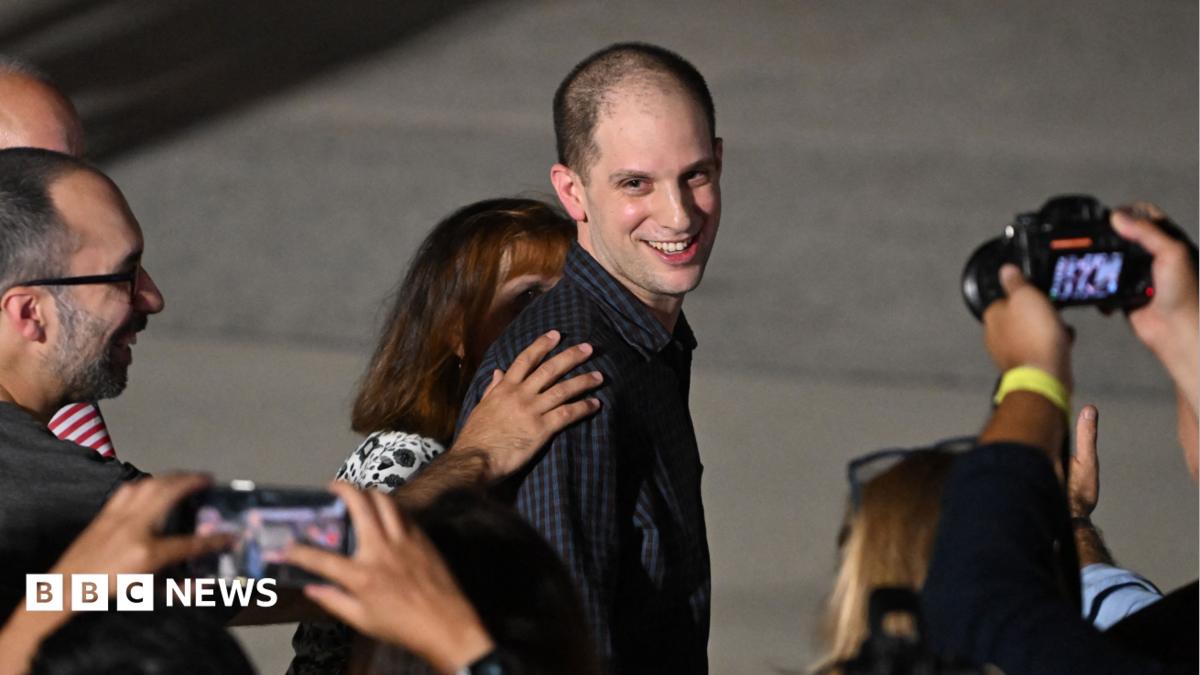
When masked men walked into a half-empty restaurant in Yekaterinburg and told Evan Gershkovich they had booked his table, the American journalist understood almost immediately that his life had changed beyond repair. In his first extended reflection on the arrest that led to sixteen months inside some of Russia's most feared prison walls, Gershkovich described the episode as a carefully orchestrated trap designed not to punish a spy, but to manufacture a hostage.
Speaking to BBC Radio 4's Today programme, the thirty-four-year-old recounted how he had travelled roughly 1,600 kilometres east of Moscow in 2023 to meet someone he believed was a source for a story. Instead, roughly half a dozen masked operatives surrounded him. The phrase they used — a casual claim to his table — struck him as strange at first, but he later recognised its purpose: it froze him in place long enough for the arrest to unfold without resistance.
It was only when his captors identified themselves as officers of the FSB, Russia's domestic security service, that the full weight of the situation settled on him. In that instant, Gershkovich said, he realised the encounter had been planned at the highest levels. The man he had come to meet simply vanished into the crowd, confirming that the rendezvous had been arranged to deliver him into custody.
What followed was not the ordeal he had been conditioned to expect. There was no interrogation, no torture — the customary tools Russian security services have historically used against suspected spies. That absence, rather than comforting him, became its own kind of revelation. Gershkovich described a peculiar sensation of relief washing over him as he grasped the logic of his captivity: Moscow was not treating him as a genuine intelligence asset, but as a commodity.
He concluded that the case against him had been fabricated so that he could serve as a valuable bargaining chip — "a pawn in a greater game." That realisation, bitter as it was, gave him an unexpected form of stability. It told him his imprisonment would likely be long, but not indefinite. He did not expect to serve anything close to the twelve-to-twenty-year horizon that a conviction on espionage charges would ordinarily imply.
The Wall Street Journal had stationed Gershkovich in Moscow since 2017, and he and his employer have consistently rejected the espionage allegations as false. His prediction that his detention would trigger an international outcry proved accurate. News organisations worldwide covered the case, his photograph appeared on a billboard in Times Square, and then-US President Joe Biden publicly declared that securing his release carried "no higher priority."
Gershkovich believes that global attention was itself part of Moscow's calculation. A high-profile foreign correspondent, he argued, made for an exceptionally valuable prisoner — one who could eventually be exchanged for a Russian operative held abroad. The eventual swap, he noted, bore out that strategy. Vadim Krasikov, an assassin serving a life sentence in Germany, was the figure Moscow wanted back. In Gershkovich's blunt assessment, the Kremlin achieved its objective without facing meaningful sanctions, a manoeuvre he described as shrewd if viewed cynically.
During his detention he was held at Lefortovo jail in Moscow, a facility with a grim history. Over the decades it has housed prominent political prisoners and dissidents, and during Joseph Stalin's Great Terror in the 1930s, torture and execution were routine within its walls. Gershkovich characterised his time there as profoundly isolating, confined to a tiny space in conditions that wore on him psychologically.
Yet he was careful to draw a distinction between his treatment and that of others. He said he was permitted to sleep and that the food was adequate. His decision to smile at cameras during court appearances was deliberate — a signal to the outside world that he remained defiant and unharmed. If the proceedings were theatre, he reasoned, there was no reason to let Moscow dictate the script.
That contrast forms one of the most striking elements of his account. Gershkovich explicitly acknowledged that many held in Russian prisons endure far worse: torture, starvation, denial of hot water, and the deliberate cruelty of being told they will never see their families again. He pointed to the case of Ukrainian journalist Viktoriia Roshchyna, who died in Russian captivity in 2024 at the age of twenty-seven. When her body was eventually returned months later, reports indicated signs of torture and the removal of her organs.
Gershkovich learned three weeks in advance that a swap was being arranged, a period he described as excruciating precisely because each day stretched unbearably. The exchange finally took place on 1 August 2024, bringing what he called pure joy. But that euphoria proved fleeting. Once the adrenaline subsided, he was left confronting the difficult reality of rebuilding a normal life — a phase he found genuinely overwhelming at times.
Now based in Berlin, Gershkovich has begun the slow process of processing what happened to him. His account offers a rare window into how the Kremlin weaponises its legal system against foreign journalists, converting criminal charges into diplomatic leverage. It also serves as a reminder that his relative treatment was the exception rather than the rule inside a prison system where others have paid with their lives.








Comments (0)