 yoga-mahendra
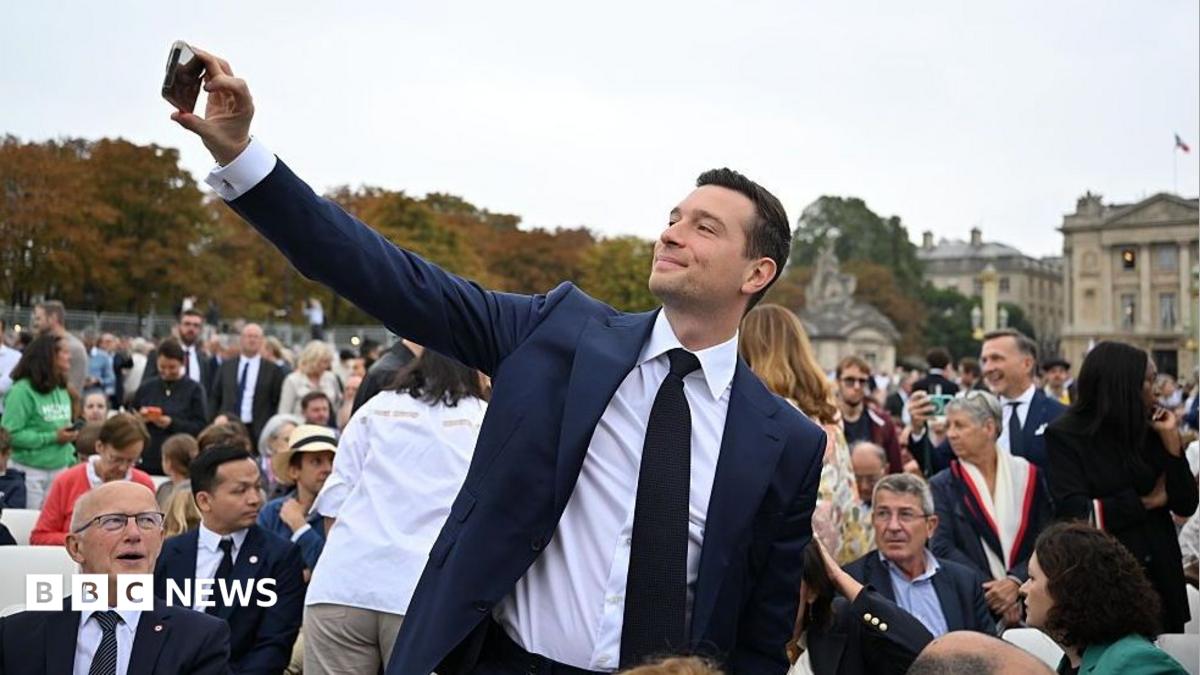
Jordan Bardella, the president of France's hard-right National Rally (RN), has announced he will pursue a libel case following a media report alleging he made antisemitic remarks as a young political activist. The controversy, which erupted this week, has injected a volatile new element into a French election campaign already marked by the far right's surging momentum.
The Mediapart website published what it described as the culmination of "several months" of investigative work involving "dozens of written conversations" attributed to Bardella from 2013. The outlet did not release screen captures of any of the alleged messages, saying instead that it had "independently authenticated" the exchanges, which were drawn from "a bigger documentary base corroborated by witness statements."
Among the remarks Mediapart attributes to Bardella, who was 17 or 18 at the time, are several overtly antisemitic claims. The report cites statements including "All the banks are owned by Jews," "The Jew has to dominate other people, crush them and rob them," and "What they want is a new world order dominated by Israel, with of course Jerusalem as its capital." The alleged comments evoke longstanding antisemitic conspiracy theories that have circulated in extremist circles for generations.
Bardella, now 31, categorically rejected the allegations, characterising them as a fabrication designed to sabotage his party's electoral prospects. "Everything is going to be done to destabilise the campaign," he told CNews television on Monday evening. "Either Mediapart is running this operation itself, or it is being manipulated by interested parties. Of course I have instructed my lawyer to sue for libel."
The timing of the report is significant. France's presidential election is just seven months away, and opinion polling suggests the RN is better positioned than ever to capture the Élysée Palace. Bardella, who would in all likelihood become prime minister if Marine Le Pen wins the presidency, denounced what he described as "the beginnings of a total war" aimed at destabilising his party.
Le Pen, the RN's presidential candidate and daughter of the party's historic founder Jean-Marie Le Pen, offered unequivocal backing to her protégé. She said the alleged remarks "seem so weird that they can only be a forgery – one of those dirty tricks for which Mediapart appears to hold the secret." Her intervention signals that the party intends to fight the allegations aggressively rather than allow them to dominate the news cycle.
Mediapart is an avowedly left-wing investigative outlet with a track record of exposing scandals across the political spectrum. Over the years, its targets have included politicians of all stripes, lending it a reputation for independence even among critics who dispute its ideological leanings. The site's decision not to publish the underlying screen captures has drawn scrutiny, though its editors insist the material was verified through multiple channels.
The political fallout has been immediate. Left-wing politicians have called on Bardella to resign, arguing that the alleged comments disqualify him from holding high office. Yonathan Arfi, the head of Crif, the umbrella organisation representing French Jewish communities, said the reported remarks "were an illustration of the limits of the RN's clean-up act" – a pointed rebuke of the party's long-running effort to present itself as a mainstream force.
The RN has expended considerable energy in recent years attempting to distance itself from the antisemitic currents that once ran through the French far right. Under Le Pen's leadership, the party has sought to professionalise its image, moderate its rhetoric, and refocus its hostility on militant Islam, a stance it shares with many Jewish voters. The RN has even styled itself as a "shield for the Jewish community," a positioning that would be severely undermined if the Mediapart allegations were substantiated.
Bardella himself has been central to that rebranding effort. Last year he became the first senior figure from the party to be invited to Israel, attending a conference on antisemitism – a visit that was widely interpreted as a symbolic milestone in the RN's rehabilitation. The alleged comments, if genuine, would reach back to a period before that transformation and cast doubt on its durability.
RN deputy Jean-Philippe Tanguy offered a different account of the report's origins. He asserted that the source of the allegations was disaffected former party members who were expelled years ago because of their antisemitic views. "From what I know, it is the antisemitic rabble that were so bravely purged by Marine Le Pen," he said. "At the start of the 2010s, they were numerous and well-organised, but they were defeated. These people have always had it in for us."
The controversy unfolds against a backdrop of remarkable electoral strength for the RN. The latest polling, conducted by Toluna-Harris, shows Le Pen winning the multi-candidate first round of the presidential election with 35-36 percent of the vote. In a two-way run-off, she would face Jean-Luc Mélenchon of the radical left, whom the survey projects she would defeat by a landslide margin of 69 percent to 31 percent.
Perhaps more striking for the political establishment, the same poll indicates Le Pen would comfortably beat Edouard Philippe, the most popular centrist candidate, by a score of 57 percent. Such figures suggest that the RN's appeal now extends well beyond its traditional base, penetrating segments of the electorate that were once reliably opposed to the far right.
The party received a further boost on Sunday, when results from a partial election for the upper house of parliament, the Senate, produced enough seats for the RN to form an official group for the first time. That development grants the party additional parliamentary resources and procedural influence, consolidating its institutional foothold.
Mediapart's report claims that the far-right current to which Bardella's alleged remarks belong has never been truly eradicated from the RN but merely covered up beneath its modernised exterior. That assertion strikes at the heart of the party's credibility strategy, and it is likely to fuel debate about whether the RN's transformation is genuine or merely cosmetic.
For now, the party appears unified in its response, with Le Pen and senior deputies closing ranks behind Bardella. Whether that solidarity can withstand further revelations, legal proceedings, or shifting poll numbers remains an open question. With the presidential election approaching, the stakes could hardly be higher – for Bardella personally, for Le Pen's ambitions, and for the trajectory of French politics as a whole.









Comments (0)